Duality, Cause & Effect and Word & Form
Ontology is the branch of philosophy that deals with the nature of Being. What is? Is there a Fundamental Unit of Being? Many physicists suggest the world is made of material particles or atoms, or some say strings. These are supposedly units of matter that create the material world. While physicists have discovered many useful mathematical formulas to describe the properties of matter, the success of these formulas does not establish the theoretical ontological models they propose.
In order to better understand the ontological foundation of Nature, we need to investigate not just matter ('Form') but also the language we use to discuss it ('Word'). Word here means Symbol. The main thesis of this article is that the Fundamental Unit of Being is not a particular Form, nor is it a particular Word, but a particular Relation between Word and Form.
There are many examples of relations between Word and Form. One very common relation that is contained in Human Languages is Naming - assigning names to forms (apples, crocodiles, humans, minerals, etc). This relation (taxonomy) is an arbitrary assignment that provides no special insight into Nature. Another common relation is Counting - assigning number labels to cardinality of sets. This relation captures a property of Forms that is undeniably useful.
A lot of what people consider modern technology was partly aided by exploring useful relations between Word and Form. The concept of Temperature is a good example of a constructed relation between Number and Form. Numbers are Primordial Words.
Temperature is a Word that describes a Form (Heat). How hot should the water be if I want it to boil? 100 degrees Celsius. This kind of Linear Thinking, associating Number with Forms, has value in Engineering for Precision, Prediction and Automation.
Computing is another example of an extremely useful constructed relationship between Word and Form. By representing Form (images, videos, sounds, concepts) as Word (binary), and Word (binary) as Form (storage, memory, electromagnetic waves), it allowed for manipulation of Words and Forms and communication.
Is there a Fundamental Relation between Word and Form?
The many Relations between Word and Form that we have mentioned are constructed by humans. However, there is one Relation that is more Fundamental than all other Relations. This Relation is the Law of Cause and Effect that expresses Duality.
Every Cause in Nature has two immediate Effects, that are also Dual to each other. When you flip a light switch (Cause) in a dark room, there are two immediate Effects - Birth of Light and Death of Dark. These two effects are like two sides of the same coin - one cannot happen without the other. They are interdependent. At the same time, Birth is the opposite of Death, and Light is the opposite of Dark. Birth and Death always arise together, while being opposites. This is called a Duality. Duality is defined by two properties - interdependence and orthogonality ('oppositeness').
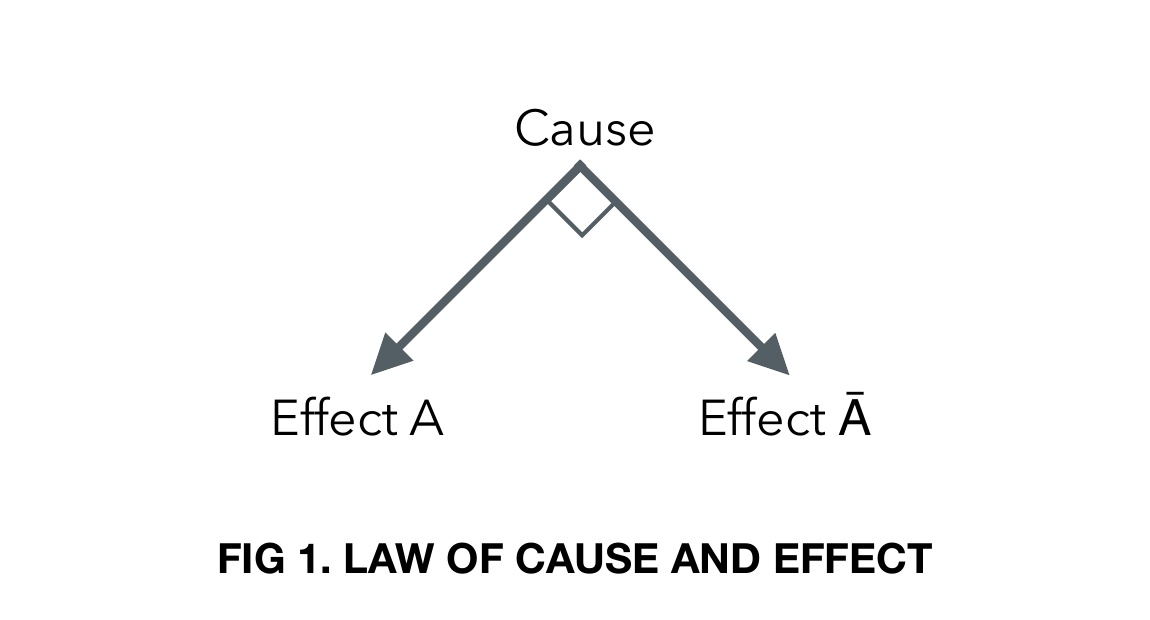
All the secrets of Ontology are contained in the above symbolic representation of the Law of Cause and Effect which expresses Duality. This symbolic representation is the most Fundamental Relation of Word and Form.
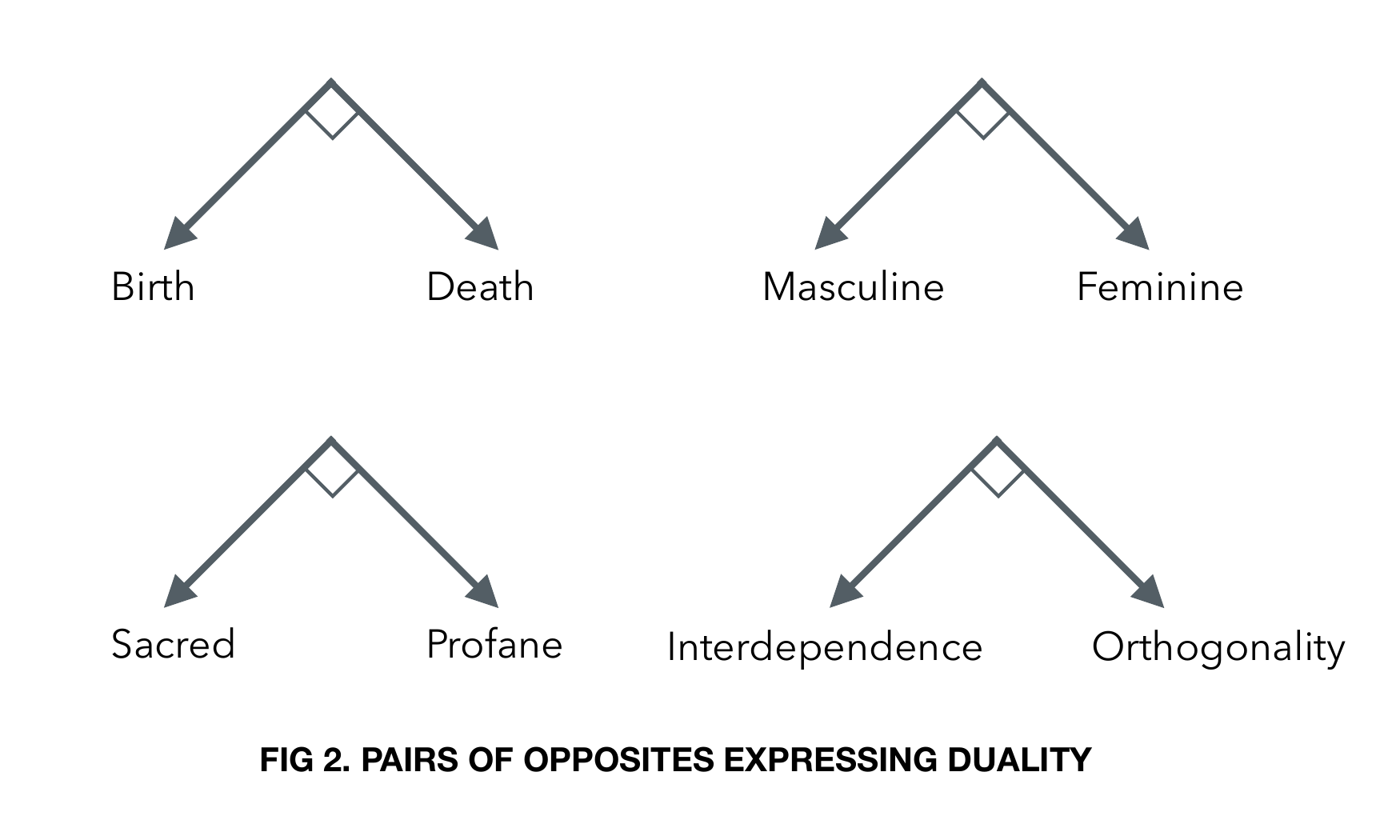
Good and Evil, Pleasure and Pain, Sacred and Profane, Masculine and Feminine, Individual and Collective, Same and Different, Form and Emptiness, Being and Non-Being, Birth and Death, Being and Becoming. These are all pairs of opposites that are interdependent, thus expressing Duality. Interestingly, even the two properties that define Duality (interdependence and orthogonality) are themselves a pair of opposites that are interdependent, thus expressing Duality.
“In the beginning there was the Word”. When you look up a Word in a dictionary, you find its meaning explained using other Words. There is no Fundamental or Primordial Word. Words inter-are. The same is true for Form. When you inspect any Form, you see that it is only made of other Forms. Forms inter-are.
This seemingly simple idea has deep consequences because of its generality. One immediate consequence of is that there is no First Cause - either an event in 'Time' like the creation of the universe or a Primordial Form like an atom or a 'fundamental particle'. Every Cause is an Effect and every Effect is a Cause. The act of Creation is always an act of bringing together elements with a specific set of relations to each other.
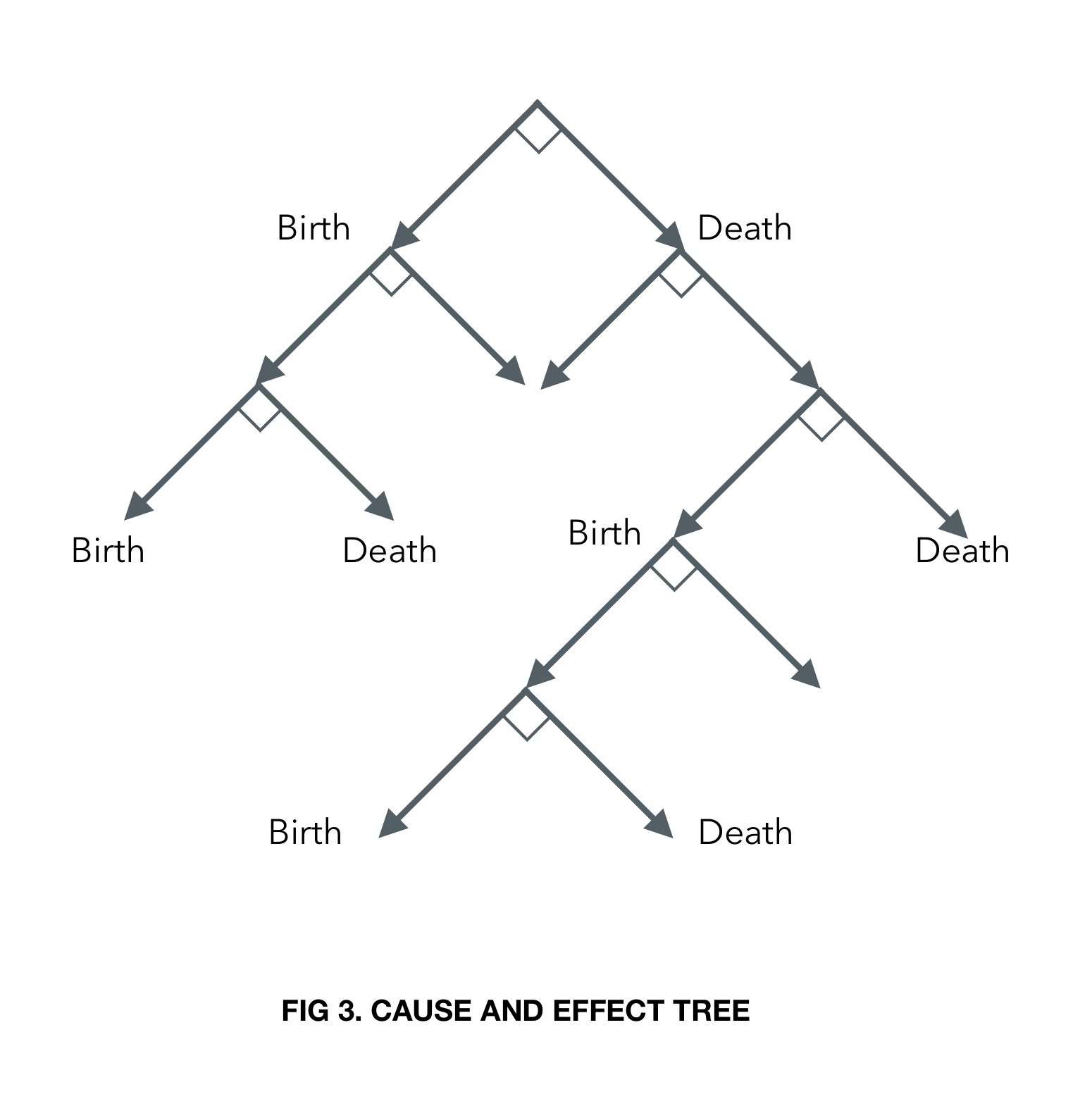
The statement that there is no First Cause implies that all Phenomena are Conditional. This conditional nature of all phenomena is what Buddhist philosophy identifies in the concept of Emptiness.
Finally, Word and Form themselves express Duality. Without Form, Word has no Meaning. Without Word, Form has no Identity. Thus Word and Form (Signifier and Signified) are interdependent while being opposites.